


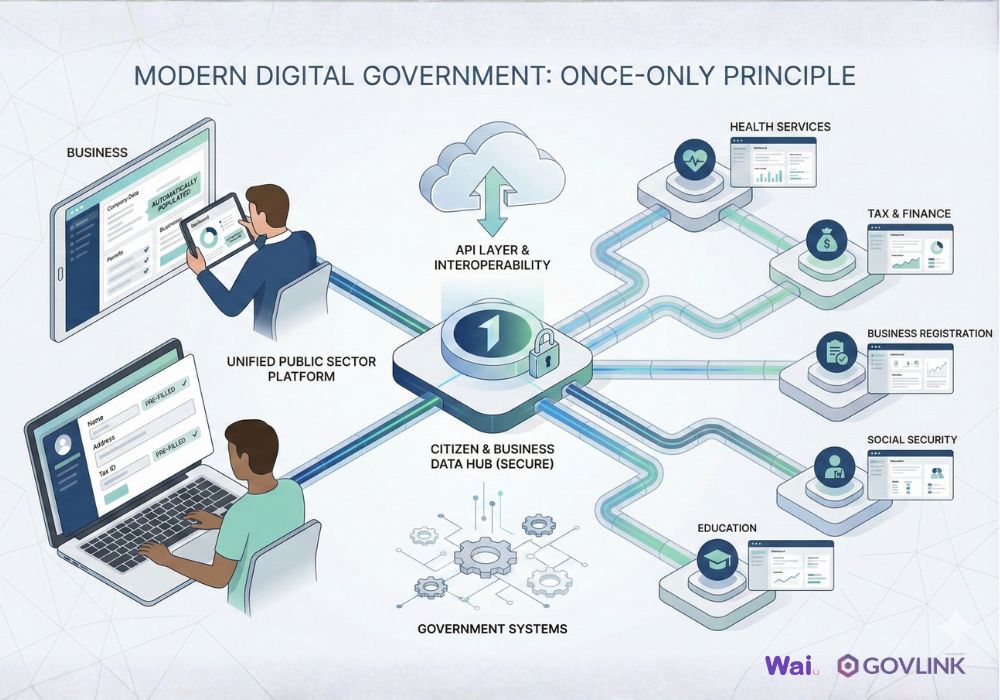
The Principle of “One Time Only”.” (Once-Only Principle, OOP) is a pillar of digital government that proposes that citizens, companies and organizations must only provide certain standard data once to the Public Administration., and that, with consent and within a framework of data protection, that information can be reused internally by authorized agencies. With this approach, administrations do not repeatedly ask for the same information in different procedures.
Its goal is not only to “digitize forms”, but to build interoperable and efficient digital public services that reduce the administrative burden, The new system is designed to improve the user experience and optimize the internal operation of the State.
Key fundamentals
- Data shared only once: The citizen enters standard data (identity, address, CUIT/CUIL, etc.) only once, and then this data is automatically reused in different services.
- Consent and protection: The exchange is subject to data protection regulations and the consent of the owner.
- Interoperability: Public systems communicate with each other through standards, APIs and interoperability layers to query and reuse data.
Operational and service benefits
Implementing the “One Time” Principle allows:
- Reduce duplicate paperwork: Fewer forms, less paperwork, fewer loading errors.
- Faster and more automated processes: Less manual intervention in validations.
- Better citizen experience: The user does not repeat information.
- Improved data quality and consistency: A single verified piece of information circulates among agencies.
- Internal efficiency: Lower operating costs and reduced administrative burdens.
Real and practical use cases
Specific examples of how this principle is or can be applied in municipal governments, provincial governments, decentralized agencies and at the national level are described below.
Management of municipal procedures: authorizations and permits.
Context: A local business must repeatedly present personal documents, proof of CUIT, rental agreement or deed, floor plan or even previous authorizations.
Application of the Principle:
- The municipal system automatically obtains basic identity and CUIT/CUIL data from a reliable source.
- Previous qualification data is reused if they have already been validated in previous procedures.
- The forms are automatically precomplete, reducing errors.
Result: Less time for citizens and greater efficiency for municipal staff.
2. Driver's licenses
Context: Driver's license applications or renewals often require duplicate data and certificates; for example, the famous “libre deuda”.
Application of the Principle:
- The system accesses identity and address without asking the citizen to re-enter them.
- Data such as violation history and clearance certificates are automatically validated from authorized systems.
Result: Faster processes and fewer additional documentation requirements.
3. Enrollment in social programs and subsidies
Context: In order to access subsidies, family, housing or economic situation documentation is often requested repeatedly.
Application of the Principle:
- The government automatically queries data from social, tax or household patterns when there is consent.
- The person does not repeat documentation already verified.
Result: Less paperwork for the citizen and faster assignment of benefits.
4. Digital front desk and citizen service
Context: A citizen submits a general complaint or request to different areas of the government.
Application of the Principle:
- The digital platform recognizes the citizen once authenticated.
- The system queries already stored basic data and pre-filled forms.
- The company maintains a centralized interaction profile with the State.
Result: Coherent and fluid experience, without repetition.
5. Procurement and suppliers
Context: Suppliers repeatedly upload tax documentation, certifications and background information for bids.
Application of the Principle:
- The supplier base reuses verified data from official records.
- Tax records and certifications are automatically consulted.
Result: More agile participation in contracting processes.
6. Health services and continuity of care (European case)
In countries such as Estonia, the principle is integrated with the electronic health record, where professionals consult clinical data without asking the patient to provide it repeatedly, and the data is updated from a central repository.
International implementation examples
- Estonia: The principle is at the heart of the digital infrastructure: data is uploaded once and reused in procedures such as document renewal, tax services and health.
- Belgium: Law of 2014 obliges administrations to obtain data from official records instead of re-requesting them, enabling interconnected electronic services.
- Spain: The Data Brokerage Platform allows organizations to consult certified data and replace paper certificates.
Getting started in local government
- Identify critical data: CUIT/CUIL, identity, domicile, family ties, representation of legal entities.
- Establish authentic sources: Official repositories with version control.
- Building interoperability: APIs, data buses and shared platforms.
- Ensuring governance and security: Permits, traceability and standards.
- Implement pre-filling in key procedures: Intelligent forms that leverage existing data.
In any case, the technical solution is simple when the political decision exists; as we always say, today technology and innovation are no longer a simple technical decision.
The One Time Principle“ is more than a concept, it seeks Simplify citizen services by improving the citizen experience. With its adoption, governments reduce bureaucracy, increase data quality and free up time to focus on higher impact policies.